


By Max Leone
Why does your business struggle…where do we begin?
The Big 23
From a variety of conventional business survey data points, these 23 items listed below in no particular order, seem to be the biggest culprits that have been identified:
1. Lack of new customers
2. Poor cash flow management
3. Disjointed Strategic Alignment
4. Lack of vision
5. Overdependence on a few very large customers
6. Insufficient on time deliveries
7. Poor or inadequate business plan
8. Lack of industry knowledge
9. No innovation
10. Hiring the wrong people
11. Lack of flexibility
12. Unsound Leadership
13. Clear product and or service differentiation
14. Lack of competitive knowledge
15. Out of control finances
16. Faulty internal and external communication
17. Poor quality
18. Insufficient customer service
19. Lack of passion
20. Incompetent managers
21. Lack of accountability
22. Poor or nonexistent marketing plan
23. Deficient certifications
To Fail or Not To Fail
Obviously, each of these can be discussed in detail with their own specific nuances and leave a lot of room for potential interpretation and finger pointing within organizations.
However, the reality is that many of these items are what all modern businesses need to address and to put their collective arms around. Taking these very seriously should be paramount for all companies if they intend not to struggle and perish the thought, not to fail!
The Cambridge Dictionary has defined struggle & struggling in a very interesting and clear business context;
Unsuccessful but trying hard to succeed
&
To be in danger of failing or being defeated
Wow…some really “punch in the face” descriptive verbal reality of what a struggling business may be going through.
Speaking of danger of failing or being defeated, Zippia, Inc. recently published some gripping information on the rate of actual failure for small businesses.
This data is interesting as it indicates the trend of failure for small business in both percentage and in years. The disquieting fact is that even longevity in business, does not guarantee less struggle and failure over time. In fact, the more seasoned company’s had a higher failure rate overall.
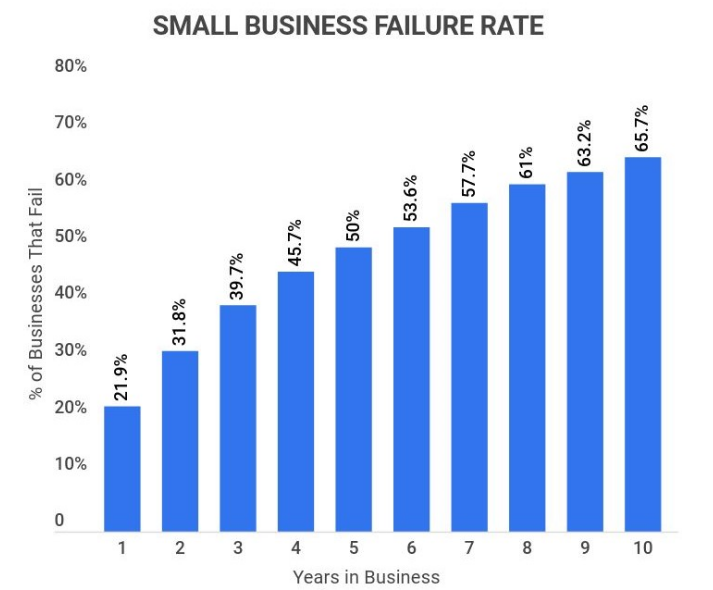
Zippia Inc. Data 2022
Focus On THE One Thing
Each one of the 23 culprits listed are important to address. However, I would like to propose the theory of the One Thing concept for you to consider for helping your business lessen the struggle it’s experiencing and possibly avoid failure.
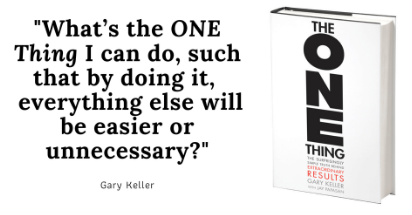
In the non-fiction Wall Street Journal & New York Times bestselling book The One Thing: The Surprisingly Simple Truth Behind Extraordinary Results, authors and entrepreneurs Gary W. Keller and Jay Papasan discuss the value of simplifying your overall workload by focusing on the one most important task.
The authors cite Italian economist Vilfredo Pareto as one of the inspirations behind this One Thing philosophy. Pareto's principle (80-20 Rule) suggested that 20 percent of the effort produces 80 percent of the results. So, engaging in the one most important item will be more likely to produce the desired results.
The One Thing KEY Focusing Question:
Strategic Alignment Is THE One Thing You Should Do For Your Business
I advance that the ONE key reason for struggle in business, is the failure of many leaders to focus on real Business Alignment. Basically, to concentrate the alignment of ALL the parts of their organization to best support its driving purpose including its foundational business strategy and how that alignment strategy is communicated and effectively implemented in the company.
By embracing and incorporating a synchronized business alignment process within your organization, you will have the driving purpose, management systems, capabilities and employee engagement necessary to really propel your organization.
This statement has a strong sense of justification when you look at just some of the overwhelming research data & statistics below on today’s business environment:
- 88% of executives say that strategy implementation is important to their organizations however 61% acknowledge that their firms often struggle to bridge the gap between strategy formulation and its day-to-day implementation. Source: Project Management Institute
- Only 14% of the organizations report that their employees have a good understanding of their company’s strategy and direction. Source: Metrus Group
- Only 10% of employees understand their organization’s strategy and how their efforts connect to the strategy. Only 40% of managers have a clear understanding of their organization’s strategy. Source: Watson Wyatt Worldwide (Towers Watson)
- 61% of employees don’t know their company’s mission statement. Source Achievers Survey
- Only 16% of employee participants are fully engaged, with 22% totally disengaged. Source: Modern Survey
- Organizational employee level of engagement study: Source: Harris Interactive Research
- Only 30% of companies reach their goals
- Only 15% of employees can identify their company’s goals and priorities
- 51% of employees don’t understand what they need to do to meet the goals
- 51% work on things that are urgent but not important
- 81% feel no ownership in getting the goals completed
- Organizations must focus on improving their agility and their strategic alignment. There is a clear imperative to take action now, due to modest economic growth forecast & shifts in the customer landscape. Source: Project Management Institute
- Companies that exceeded revenue were 2.3X more likely to report high levels of alignment. Source: Inside View
- Highly Aligned Companies grow revenue 58% faster & are 72% more profitable that their misaligned counterparts. Source: LSA Global
- $109 million is lost for every $1 Billion in project spending due to misalignment. Source: Project Management Institute
You Are Not Alone
There are thousands of companies that are struggling and operating far below their potential each day. A main reason may be that their businesses are simply not well aligned to address todays ever demanding and changing business environment.
It can be difficult for businesses to stay on track with their mission and goals. There needs to be a clear understanding of the purpose that they serve in order to align themselves with the right audience, strategy and mission. In order to make sure things are going in the right direction, a company needs people who are committed and passionate about what they do.
If a business is not aligned, it will not be as successful as they could be. The purpose of a business is to meet its mission and goals. If it is not meeting these factors then it needs to reevaluate what they are doing wrong.
Many business leaders may instinctively feel a lack of alignment in their company but can’t pinpoint the driving misalignment issues. This is a common and reoccurring dilemma.
The best way to explain this is the idiom “you can’t see the forest for the trees” meaning the organization can’t see the big picture because the focus is too much on the day to day details.
Sometimes, having a non-emotional, third party professional do an alignment assessment of your organization may be the easiest and fastest way to highlight areas of concern, misalignment and potential change.
Conclusion
Elon Musk has been in the news quite frequently. Whether you like him or hate him for whatever reason, business leaders worldwide have been incredibly impressed with his diverse success with the Tesla & Space X organizations (jury still out on Twitter).
When considering the path of addressing business alignment and its potential positive implication to alleviate struggle and failure and promote business growth, I would point to one of his more famous quotes.
"Some people don't like change,
but you need to embrace change
if the alternative is disaster." Elon Musk
Optimize Your Business Now! Are You READY?...