
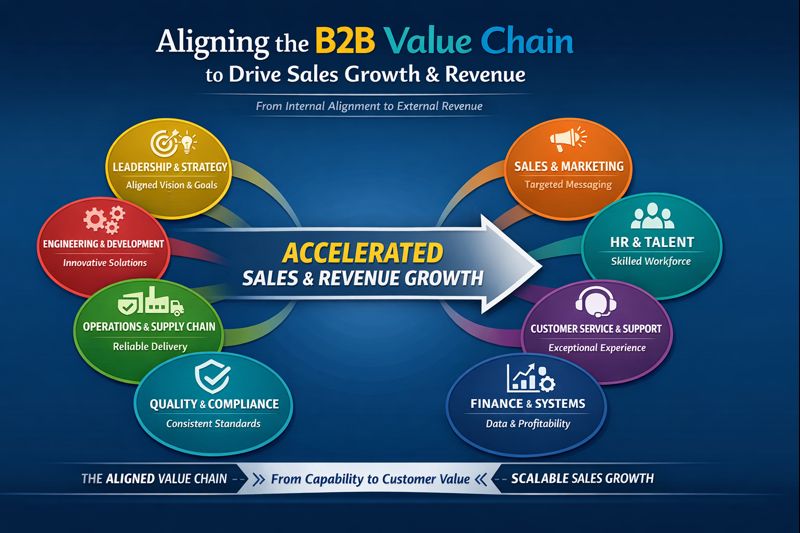
Most B2B leaders think of sales growth as the responsibility of the sales team. That assumption alone quietly caps revenue.
In reality, sales performance is the downstream result of your entire B2B value chain, every function, department, and decision that shapes how value is created, delivered, and experienced by your customers.
When that value chain is aligned, sales accelerates.
When it’s fragmented, sales stalls no matter how talented your salespeople are.
At Ready To Align, we see this pattern repeatedly across small and midsize B2B companies: sales struggles are rarely sales problems, they’re value chain problems.
Let’s break that down.
What Is the B2B Value Chain…Really?
At its core, a B2B value chain is the end-to-end system of activities that turns capability into customer value and revenue.
It includes far more than operations or production. In high-performing B2B companies, the value chain spans:
- Leadership & Strategy
- Sales & Marketing
- Engineering & Product Development
- Operations & Supply Chain
- Quality & Compliance
- Human Resources
- Customer Service & Support
- Finance & Systems
Each function either reinforces or erodes your value proposition, whether intentionally or not.
Your customer experiences the sum of these parts, not just your sales pitch.
How Each Function Impacts Sales Growth
Leadership & Strategy: The Revenue Tone Setter
Sales growth begins with clarity at the top.
When leadership lacks alignment on:
- Target customers
- Value priorities
- Growth objectives
Every department optimizes for its own goals, and sales becomes reactive instead of strategic.
Aligned leadership ensures every function supports WHO you target, WHY customers choose you, and HOW you win business.
Sales & Marketing: Translators of Internal Value
Sales and marketing do not create value, they translate it.
If operations are inefficient, quality is inconsistent, or customer service is reactive, sales is forced to:
- Over-promise
- Discount
- Defend internal gaps
When aligned with the value chain, sales confidently sells outcomes, not excuses.
Engineering & Product Development: Competitive Differentiation Engines
Engineering defines what’s possible for sales.
Well-aligned engineering:
- Designs for customer pain points
- Enables customization where it matters
- Reduces downstream quality and delivery issues
Misaligned engineering creates products sales can’t clearly position—or worse, can’t reliably deliver.
Operations & Supply Chain: The Credibility Backbone
Operational performance directly impacts:
- Delivery reliability
- Scalability
- Cost control
Sales promises only work if operations can fulfill them consistently. When operations are disconnected from sales realities, growth creates strain instead of momentum.
Aligned operations turn growth into a repeatable advantage, not a risk.
Quality: Trust, Retention, and Expansion
Quality is not a compliance function, it’s a revenue multiplier.
Strong quality systems:
- Reduce churn
- Increase customer confidence
- Enable long-term contracts and renewals
Poor quality forces sales into constant recovery mode, damaging trust and eroding lifetime value.
Human Resources: Growth Capacity Builders
People power your value chain.
HR directly affects sales growth through:
- Hiring aligned talent
- Onboarding consistency
- Skills development
- Culture reinforcement
If your people don’t understand the customer, the value proposition breaks down at every touchpoint.
Customer Service & Support: The Silent Sales Force
In B2B, post-sale experience is pre-sale influence for the next deal.
Customer service impacts:
- Renewals
- Upsells
- Referrals
- Reputation
When service is aligned to sales objectives, customers become advocates, not liabilities.
Finance & Systems: Visibility and Scalability Enablers
Financial systems determine:
- Pricing discipline
- Profitability by customer
- Investment decisions
Without clean data and aligned metrics, sales growth can look healthy while profitability quietly deteriorates.
Why Misaligned Value Chains Stall Sales Growth
When functions operate in silos:
- Sales pushes deals operations can’t support
- Engineering builds features customers didn’t ask for
- Quality fixes problems that shouldn’t exist
- Customer service absorbs frustration instead of building loyalty
The result?
Inconsistent performance, longer sales cycles, margin pressure, and stalled growth.
The Ready To Align Perspective: Value Chains Drive Revenue Systems
High-growth B2B companies don’t treat alignment as a soft concept, they treat it as a sales growth discipline.
At Ready To Align, we help organizations:
- Align every function to the customer value chain
- Connect internal execution to external revenue
- Build sales systems that scale because the business is aligned
Sales growth is not a department.
It’s a byproduct of alignment across the entire value chain.
Final Thought
If your sales growth feels harder than it should…
If your teams are working hard but results feel inconsistent…
If revenue plateaus despite strong products and people…
The issue is rarely effort.
It’s alignment.
And alignment starts with understanding how every part of your B2B value chain either fuels or restricts sales growth.
-Ready To Align